Select Language:

Work Hard to Hardly Work

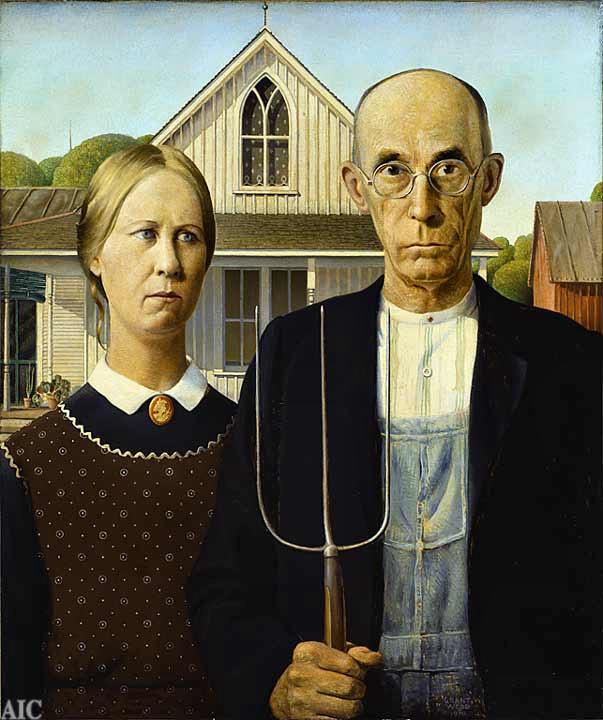
american gothic painting

You’ve probably seen this painting periodically throughout your life called American Gothic by the artist Grant Wood. It shows an older man and woman, farmers presumably, standing stoically in front of a farmhouse, the man holding a pitchfork.

Art is subjective—what you see may not be what someone else sees—but even the casual viewer of this painting will see two people devoid of any emotion that would make the viewer stoked about the idea of ‘hard work.’

The painting, so the myth goes at least, points toward the idea that hard work is a rewarding virtue in itself. It’s implied as if the reward of hard work is something that just naturally happens as a result of our having ‘paid dues.’

Please understand I’m not ragging on farming or anything that requires hard, physical labor. I am, however, ragging on the idea that hard work is a ‘virtue’ that we should be carrying into our retirement years.

Unfortunately, these myths we grow up with impact our psychology more than we sometimes give credit. So many people judge success on superficial factors—like the prideful vanity of using a line like “I work hard” to bludgeon other people with—but also on the wrong metrics of measuring success to begin with. The number of hours worked and tasks completed may produce more money per paycheck, but it’ll also mean you’ll end up with those long, tight faces like in American Gothic.

Do years of hard work and little enjoyment of life, yet having a ‘comfortable’ retirement, equate to success? Maybe, but you could just as easily look at it as poor time management and a waste of personal strengths and skills—doing stuff that (often) makes us miserable for a little bit more money and for vanity’s sake—“I’m a hard worker.”

If we’re honest with ourselves, the only realistic goal of playing the money game while being truly happy and fulfilled is to play for eventual freedom from work—way sooner than retirement. Don’t misunderstand me here: the most valuable things in life aren’t going to come easy and they’re often not going to come without some pain and effort.

If you’re going to work hard, you might as well be working hard at working less.

The real measure of success is how free you are—financially, mentally, emotionally, and spiritually—to live life the way you want to live it.

Now it’s your turn, I want to hear from you! How are you going to practice working hard at working less right now? Or better yet, what specifically in the financial, mental, emotional and spiritual areas of your life will you practice this principle? Share your comments here, your feedback is valuable!

There’s No Freedom in Waiting to be Rich

empty wallet


It’s one of the most basic questions ever: What do you and 99% of the population want most?

Most people will say “More money.” Specifically, we want to be rich. Who wouldn’t? If you’re rich, you really don’t have much to worry about, except maybe what to do with all that money, or maybe what to do with that “distant cousin” you never knew, who all of a sudden shows up when they find out you’ve got some money. Still, that’s a problem most people will gladly accept.

More money means material comforts, and doing what you want when you want without having to answer to anybody. No bosses, no deadlines, no evaluations—being in charge of your own life. Since this is so apparent … why are we even talking about it?

Because sometimes, the obvious is so obvious that we miss the bigger picture. When we talk about wanting to be rich, what are we really talking about; money, or freedom?

There’s a pretty big difference between the two, no? Does having more money absolutely mean having more freedom, or security, or even peace of mind? Not necessarily. Being rich certainly provides material convenience, but you and I know there are plenty of rich people out there who are completely miserable. Sometimes they miss the whole point of being rich—i.e. freedom and happiness. Instead, they work even more than some middle class people, who struggle just as hard, because some rich folks think they have to work harder in order to stay rich and “free.” Can you believe that?!

So in the end, what are we really after? What do we really want?

What we’re really seeking is a feeling that we associate with being rich. The house we want can give us a sense of comfort. The car we want can heighten a feeling of importance. Travel and toys can bring excitement and stave off boredom. But you don’t have to wait to be rich in order to have these things or experience the feelings of freedom and happiness.

The goal isn’t to get rich in order to be free. Let’s turn that around! Get freedom first, and then being rich becomes icing on the cake.

How do we get free now? Financially speaking, you do this by creating passive income vehicles—some to build, some to buy—letting those streams gather momentum over a few years, reaping the rewards, then doing more of this with other passive income structures. This way, you get the material wealth that gives you tangible freedom from having to worry about working—one of the basic goals of our desire to be rich—and if you really know what it is you really want, you get the happiness part of it as well.

Freedom is only as good as the results of your true intentions. In other words, keep the endgame in mind. We’re not getting rich to be free. We want to be free and then enjoy the benefits of being rich. This is not something we have to wait for to arrive in the future. There’s no freedom in waiting.  Freedom starts now.

Don’t Sell – Help!

man with help above him

There are another three components that are critical to website success—besides avoiding the pitfall of focusing on product before knowing who your target market is and where they hang out.

The first is help, don’t sell. By helping you will sell. The second is build credibility and rapport through educating.

You’ll go to a sloppily put-together webpage and get these annoying boxes that come up asking if you want something you weren’t thinking about before but are certainly too annoyed by now to entertain considering.

When you’re marketing online, remember that people don’t shop online. People research online.

Most people go online for research on how to buy a new car, or increase their business, or to learn about raw foods, or whatever it may be. So your website has to be designed around helping, not selling. Informing, revealing, educating.

If you sell, you will fail. By helping you build credibility and rapport. People will believe in you, and because of that, you can show them the value in your product or service. And they will buy from you. It’s absolutely critical to what you do online.

Everything on your website—every button, every graphic, every word you put on the page has got to be built around helping, not selling. Make it most appealing to researchers, not to shoppers. Save the two-page sales letters and the paper. Whatever it is you’re the expert in, whatever you do, they want more information. They’ll call you, email you, or order right off the website.

The mindset of the online researcher-pre-shopper is, What’s in it for me? That’s the first question you want to answer on your website. If you can’t answer that question at the top of your webpage, change it or you’re going to fail. Why should anybody stay there? They’ve got hundreds of websites to go look.

Don’t have a mission statement at the top of your page talking about who you are, what you do, how great and fantastic you are, and how you have a Ph.D. Nobody cares about that.

They care about what you’re going to do for them. That doesn’t mean not making available credentials and testimonials, but it all goes back to writing headlines—something that will make them stay. Suck them in. Make them feel like they’re going to be learning something they didn’t know before.

Nearly the same marketing rules still apply. Walk a mile in your prospects’ shoes. Empathize with them in plain language. Pharmaceutical ads are written and spoken so that children understand them. Use simple and/or precise language (depending on the uniqueness of your market) as your keywords—the words prospects would be typing into Google or Bing to find you. If you’re selling cow juice but everyone calls it milk, you better call it milk too because people don’t search for cow juice, they search for “milk.” If you get stuck, there are writers at reasonable prices who can do it for you.

It’s not how well you know your product that is going to determine the level of your sales and your success; it’s how well you know your customer, so that you’re ready for them when they visit your web page.

Next month we’ll cover that last key to success in building an online business—having the best possible sales process you can have—one that costs you nothing and boosts your profits!

https://bit.ly/UltimateInternetBootcamp

The Answer Lies in How

iStock_000015049406XSmall

From now on, whenever you have a goal, the only question you ask is, “How?” If you have a problem, the question is, “How do you solve it? How do you overcome it?”

All successful people ask how. They’re proactive. They’re action oriented, and the word ‘how’ is like pushing the button on a detonator. The answer always triggers you into explosive action. You can’t ask ‘How do I solve this,’ ‘How do I achieve it,’ ‘How do I get there,’ or ‘How do I overcome it’ without being triggered into taking an action of some kind.

If top people think about what they want and how to get it, what is it that unhappy, unsuccessful people think about most of the time? They think about what they don’t want and/or who’s to blame. That’s the basic summary of all abnormal psychology. They think about what they don’t want, which makes them unhappy, and they think about who is to blame, which makes them angry.

Unsuccessful, unhappy people are always angry at someone who they blame for their problems. The goal is to mature to the point where you realize that you are in command of your own life. You’re in charge. You make things happen. You are not a victim. That was then, this is now.

Never allow your past to determine your future. Think about what you want and how to get it.

When you turn toward the sunshine; when you think about what you want and how to get it, the shadow of negativity falls behind you. You realize you can’t change any of that stuff from the past anyway, so why fret over it anymore, yes? You have control over now. Now you can ask how. ‘Instead of what thinking about what I don’t want, what do I want, and how do I get there?’

One of the greatest wastes of life is to be upset about something that happened in the past that you can’t change. One of the great uses of life is to think about what you want in the future and how you’re going to get it. You keep your mind so focused on the future that all those other things just peel away like dead skin.

Don’t allow unhappy experiences in the past to keep re-emerging in your daily life. This is what holds us back. This is what stops people from succeeding.

Maybe some things happened to you that were beyond your control. Maybe those events had consequences that detoured or even derailed some goals in your life up until this point. Maybe you’re still living with those consequences. You are responsible for your life now. You are responsible for the things that you want and how to get them.

Nobody is smarter than you. Nobody is better than you. If they are doing better, they have just figured out how. They’ve gotten the recipe before you did, but the recipes are available to everyone.

What was the recipe for your success? How were you able to use basic, simple psychology to turn your situation around from lethargy to activity? What’s your story? We want to hear from you!

Facing the Consequences

iStock_000011255264XSmall

One of the most impactful words in our language is consequences—this concept that action means something because it creates reactions, results: consequences. When we think of “facing the consequences,” that usually means something “bad.”

Likewise, inaction has consequences in that if we don’t do certain things that can also affect our lives, and sometimes with the greatest negative consequences.

However, there can be good consequences when we face up to the choices and decisions that we’ve been putting off. Every change in life happens when our mind collides with a new idea and goes off in a different direction. Once that happens, there are an infinite number of possible consequences that can happen.

In this sense, it’s pretty elegant but simple proof that you don’t necessarily have to be super smart to create the possibilities you want—though education, intelligence, and wisdom can’t hurt. You don’t have to be super-certain—though confidence and courage help more often than hinder.

Successful people are successful because they do more things that increase the probabilities that they will achieve the success they want. The probabilities say that if you try enough things in the right ways, eventually you’ll try the right thing at the right time with the right result for you.

One of the things I’ve found with regard to new ideas is that smart people continually move themselves within a stream—where they are connecting with the right people and events serendipitously, simply because of a decision they may have made years ago that brought them to that spot. At some point that person said, “Yes, I think I’ll try this and commit to it.”

They’re in a flow where the people, and the situations, and the ideas are colliding and pin-balling back and forth. The downside to that is it can be over-whelming sometimes, causing paralysis because all these ideas sound good but—jack of all trades, master of none.

The upside is that you can never tell which idea is going to be the one you need at that time. You only know that if you increase the number of ideas, the likelihood or probability that you’ll get the right idea at the right time goes up dramatically.

And sometimes all you need is one new idea to change the whole course of your life. One small change in the ingredients can change your whole world, or maybe impact the world. We’re seeing proof positive of that across a whole region of the globe today.

Bernard Baruch, one of the wealthiest men in America back in the day, started off penniless. When asked what was the key to becoming wealthy he said, “The starting point to becoming wealthy is to decide to become wealthy.” Look at his consequences.

The average self made millionaire goes broke two or three times throughout the course of his or her lifetime, which means there’s hope for all of us. Most Americans start off broke but like it so much they keep going back to it throughout their lives. Break the cycle.

What were some of the most powerful consequences of a decision that you made in your life? What other possibilities opened up for you? Share your experiences with the Millionaire Mind community. We want to hear from you!

https://bit.ly/NewMMI