Select Language:

Practicing Happiness

elderly woman holding hands up in convertible

Practice makes perfect, right? Wrong!

First of all, nothing’s ever perfect. I’d even say you don’t really want anything to be “perfect.” Why not? Well, once you’ve reached it, where else is there to go but backwards or, even worse, nowhere?

No, the point of practice isn’t perfection. We want to strive for perfection, yes, but that’s only going to work if you understand that it’s not just about the destination but the journey as well. That’s why it helps to look at the process when it comes to those outcomes we’re reaching for. Because what would be the point of getting to where you always wanted to be if you’re beat up and worn out by the time you get there? Where’s the happiness in that?

Happiness is a process as much as an outcome. Don’t get me wrong – a hard-earned victory is awesome. But think about it; should happiness in life be restricted to success in finances, or business, or career, or the attainment of goals?

We have all been there at some point in our lives, saying something like, “If only I had [fill in the blank], I’d be so much happier.” Hey, sometimes we may even get whatever it is we think will make us happy, but what usually ends up happening? We’re psyched for a little while—if at all—and then we find out it wasn’t really enough to make us as happy as we thought it would. There’s always more.

You can work your butt off to get to where you want to be by practicing your delivery, your backhand swing, your investment strategies—you can practice anything until you get it down, but that doesn’t mean things are always going to turn out perfectly. Practice doesn’t make perfect.

Practice becomes habit, and habits become permanent unless we consciously change them. We’re practicing something all the time through our habits, even when we’re not really thinking about it. If you practice the thought that “I’ll be happy when [fill in the blank] happens,” then guess what? You’re always delaying your happiness until [fill in the bank] happens. Not because things will never be great, but because you’ve become a master at being unhappy. Unhappiness will be your habit!

You have to practice being happy no matter what is going on in life; whether you win or lose, succeed or experience temporary setbacks, whether everything is the way you have always dreamed or if you are still on the road to your next major destination.

Practice whatever you want to be in the future now. If you want to be more patient and less reactionary, then practice patience now. If you want to be a manager of your own personal wealth, start managing your finances now no matter how much money you earn. If you want to be successful, then practice being successful now. Start small. Engage in things that you’re already good at and challenge yourself to be better, even if it’s just in small increments.

The key is to enjoy the process and the journey. We can have moments of perfection, times where we wouldn’t want a single thing to change, but it’s unfair and unrealistic to ask that of life all the time. But it’s totally within our control to practice being whatever we want to be right now!

So now it’s your turn:  What are you going to practice right now?  What’s that one thing you want to achieve and are willing to enjoy the process while making it a habit?  We want to hear from you!

Take It Easy

business man kicking feet up in field

There’s a book out there called “Life Was Never Meant to be a Struggle” by Stuart Wilde. The title pretty much says it all, yes?

You sure wouldn’t know it by the way people work and live, though, would you?  The fact is most people suffer through their work if not their lives. They do what they do because they believe they have to, because they think they should, or because they’re good at it—even in the face of personal unhappiness or financial struggle.

In the past, the type of work we did was based more on necessity than choice. You just did what you had to do or what was available to you. Things have changed pretty dramatically. We have way more options and opportunities today than we can even handle.

And that’s exactly what a lot of peoples’ biggest struggle is when it comes to work. We don’t do what we love because we’re not clear about what we want.

The first place to look is at your natural talents. Natural talents are gifts from the Universe, gifts from spirit, or whatever you want to call your creator. These are things that you do well, that you didn’t have to learn to do. You’re basically born with this skill. It comes easy to you. It’s something that people look at you and go, “You’re natural at that.” And most importantly, you like doing it!

The most obvious reason a lot of people don’t find or create work that they love—and struggle through life because of it—is fear: fear of failure, fear of the unknown, fear of change, fear of rejection, fear of looking foolish, fear of disapproval and even fear of success!

Sometimes people will mask this fear as obligation: to other people, to an idea, obligation to the frickin’ mortgage. If your mortgage is hampering your life, which one do you want to release?   Well, guess which one most people release? Their life! It’s a choice: your mortgage or your life.

Whatever it is that you feel obliged to do, obligation is nothing more than a fear that if you don’t do “this,” something bad will happen. You’re not going to have passion and energy to succeed if you resent doing what you’re doing rather than looking forward to doing it.

I believe life was not meant to be a struggle, while acknowledging that struggles do happen in the form of detaching yourself from all old habits that no longer serve you in your life now. Growth is hard, but once we get through and become more of who we are, the struggle lightens.

We have to unlearn what we believe in order to escape the struggles that the illusion of separation brings—mainly separation from ourselves and from our nature that wants to make things easier.

We are part of a divine source of unlimited power—creators of our own experiences. Those with a strong spiritual connection tend to find that life is easier, living an authentic life knowing who they really are rather than playing a role that society, culture, or religion has dictated.

Then all those other areas open up—work, relationships, finances, etc. Life really shouldn’t be that hard. Unlearn, discover, apply, and for goodness sake, take it easy!

Now it’s your turn- we want to hear from you! Do you utilize your natural talents in your life and more specifically, your work? Is what you do for work your passion, or are you simply working to pay the bills each month? Share your opinion and experiences with us, your feedback is valuable to our community!


Work Hard to Hardly Work

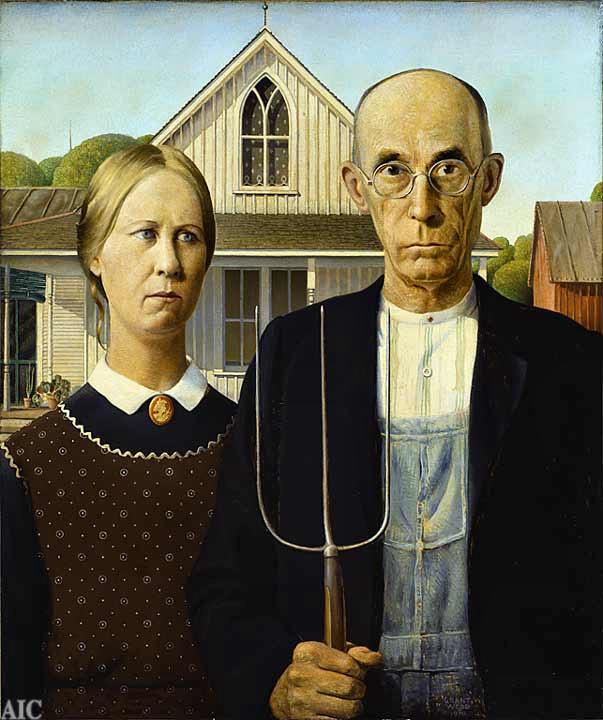
american gothic painting

You’ve probably seen this painting periodically throughout your life called American Gothic by the artist Grant Wood. It shows an older man and woman, farmers presumably, standing stoically in front of a farmhouse, the man holding a pitchfork.

Art is subjective—what you see may not be what someone else sees—but even the casual viewer of this painting will see two people devoid of any emotion that would make the viewer stoked about the idea of ‘hard work.’

The painting, so the myth goes at least, points toward the idea that hard work is a rewarding virtue in itself. It’s implied as if the reward of hard work is something that just naturally happens as a result of our having ‘paid dues.’

Please understand I’m not ragging on farming or anything that requires hard, physical labor. I am, however, ragging on the idea that hard work is a ‘virtue’ that we should be carrying into our retirement years.

Unfortunately, these myths we grow up with impact our psychology more than we sometimes give credit. So many people judge success on superficial factors—like the prideful vanity of using a line like “I work hard” to bludgeon other people with—but also on the wrong metrics of measuring success to begin with. The number of hours worked and tasks completed may produce more money per paycheck, but it’ll also mean you’ll end up with those long, tight faces like in American Gothic.

Do years of hard work and little enjoyment of life, yet having a ‘comfortable’ retirement, equate to success? Maybe, but you could just as easily look at it as poor time management and a waste of personal strengths and skills—doing stuff that (often) makes us miserable for a little bit more money and for vanity’s sake—“I’m a hard worker.”

If we’re honest with ourselves, the only realistic goal of playing the money game while being truly happy and fulfilled is to play for eventual freedom from work—way sooner than retirement. Don’t misunderstand me here: the most valuable things in life aren’t going to come easy and they’re often not going to come without some pain and effort.

If you’re going to work hard, you might as well be working hard at working less.

The real measure of success is how free you are—financially, mentally, emotionally, and spiritually—to live life the way you want to live it.

Now it’s your turn, I want to hear from you! How are you going to practice working hard at working less right now? Or better yet, what specifically in the financial, mental, emotional and spiritual areas of your life will you practice this principle? Share your comments here, your feedback is valuable!

The Real Problem is …

Businessman writing a positive concept

Last week we explored how sometimes we just need to be able to identify what we’re frustrated at in order to begin addressing it. When there are consistent frustrations in a business, we can usually address them but putting systems in place that minimize inconsistencies and produce more of the results we’re really looking for.

It’s another one of those no-duh, no brainers that may not appear like much until those frustrations build to the point of blinding us from the most direct solutions.

But we now want to articulate the impact of that frustration on our business condition. How does this thing impact you? What results aren’t you getting? What’s happening? What’s not happening that you want to happen, or don’t want to happen?

We don’t want to be working on anything that doesn’t really matter. If you’re frustrated because your partner starts their day later than you do, does it really matter as long as the work is getting done? But if that lateness means missing calls from earlier time zones, that could have an impact, yes?

So it’s one thing to name a frustration, and it’s another to know exactly what that frustration translates into toward your bottom line. You’ve got to probe, measure, and quantify that frustration. You might find at the end of the day, you’re really getting bothered over something trivial—or you could find that your frustrations are indeed warranted.

If you have a complex system you’re looking at, this process can take months. So how about a more simple formula?

The real problem in my business is the absence …” It could be a system that will cost-effectively generate leads rather than be a costly guessing game every time. Or a system that staff can follow consistently rather than doing it their own way each time, producing mediocre or inconsistent results. Or it could be the absence of a system for strategic planning rather than primarily responding to a competitor’s moves.

It’s just a generic way of focusing. You’re not actually formulating a system yet. What you’ll find is some of these things that you describe can actually be purchased as software programs, or you can easily hire consultants who do them much better than you would. But once you’ve figured out what the problem actually is, reformulating starts to become easier.

“The real problem in my business is the absence of a system that will …” Fill in the blank with that generic system solution and then write down your original frustrating condition.

You should start to feel a shift in your energy in terms of some of these things that are frustrating you. The question that you simply have to ask now is: Is this frustration worth fixing? Is this frustration that you named—if it’s not stemming from within you—something you have to address quickly or is it lower on the priority scale?

Do you really want to remedy this frustrating condition or would you rather just live with it? That’s the question that you have to answer.

What do you think? What are some frustrating aspects of running a business that you’ve encountered, and how did you remedy them? Did you find value in naming and understanding the impact of those frustrations? Were some of them really nothing? We want to hear from you!!!

Your Business Reflects You

man looking through crystal ball

If someone told you, right before you got out of the gate, “Sixty-three percent of all businesses fail within the first six years,” would you still want to start a business?

That’s the figure according to the U.S Bureau of Labor Statistics. That means most people stand a little bit better than a 50/50 chance of, at minimum, staying above water; we’re not even talking about profitability.

(more…)