Select Language:

How To Become An Instant Authority In Any Industry

harv eker on stage

Are you an expert in something? Anything? A topic you know just as good or better than anyone else?

I want to highlight the example of a student of mine who’s a car mechanic that spun his expertise into a franchise. He started out with a single garage, but thanks to some of our trainings he put together a talk on how to make sure you don’t buy a lemon: a used car that looks good on the outside but actually has more problems than the car dealer wants to admit.

He titled the program, “The 10 Biggest Mistakes Almost Everyone Makes When It Comes to Buying A Used Car.”

When he first started putting this talk together, only three people came to his little tiny garage. However, when he gave the talk again, eight people came. The next time 12 people came. Soon, he couldn’t fit the people who were coming to his talks, which he held every Monday.

Oh, and he did this for free! He didn’t charge a dime.

It’s three years later, and my former student, the car mechanic, now has six garages. When people go to buy a car in his area, they want him to check it out, they want him to fix it, and they want him to make sure that their car is in good shape because he branded himself as the expert in his market.

This is a multi-million dollar strategy for every single one of you. It’s what I call group selling, but you’re not actually selling anything. You’re just talking. You’re presenting and giving information. That is, you’re educating people but the implication in doing so is that you are indeed the expert.

Being the go-to person, expert or authority in any industry has HUGE rewards. If done correctly it will radically change your business for the better. What’s even more interesting is that it’s not that hard to do…its actually quite simple!

Just follow these four basic steps to creating a talk of your own and branding yourself as an expert:

1. Have a strong title/name for your talk. Be creative but keep it nice and simple and straight-forward.

2. Tell people who you are and why they should listen to you. Explain your expertise.

3. Provide content and information including examples and success stories if you have any.

4. Give them a call to action after your talk (where can they learn more or take a next step)

That’s it! Remember, our number 1 priority for making money from other people’s pocket: solving a problem. So simply say what problem you’re going to solve, why you’re uniquely qualified to solve it, give some free information they can use immediately–helping them for free and being accurate with that help builds trust–and then how they can continue that relationship with you the expert.

Let’s say, for example, that you’re a landscaper. You could hold a talk, program or webinar in your local area about the 10 biggest mistakes most people make when creating a garden.

At the end of it, you don’t have to sell anything! You can say something as simple as, “By the way, I happen to have a video (or e-book or whatever) that you can download,” or, “If you’d like me to help you in this area, you can reach me by calling or by clicking here” or however it is people contact you.

You’re going to double, triple or quadruple your income … I promise you!

That’s how I did it. Hello?!?

And I’m still doing the same thing!

You don’t have to believe you’re an expert. They’re going to believe you’re an expert just because you’re standing in front of them. The more you educate yourself in that area, the more you can educate others and increase your income in the way that you’re good at!

You have everything you need right now to be able to do it.

How many of you out there are doing this already? If not, what’s holding you back?

Share your thoughts, comments, or experiences. We want to hear from you!

Here is a great example of a webinar that I put together that offers GREAT upfront value and helps solve a big problem.

It’s called the Ultimate Life Makeover, reserve your seat so you can see this as a example and also get the benefits of what I teach for free.

Click here to reserve your seat for my next class.

For Your Freedom,

How To Charge What You’re Worth Without Being Greedy

value and price scale

I’ve come across lots of people who have an inspiration to teach others something they’re passionate about, and they want to be financially free as a result, but they carry guilt for charging what they perceive as huge fees that aren’t really affordable. These teachers want to make an impact, but they don’t want to be greedy about it.

I have a little experience with this.

People tend to handle this one of two ways: they either charge hardly anything or they charge as much as clients will pay.

Neither approach is wrong in itself, as long as you’re able to answer this central question: “What’s the least amount you can charge and still make a profit?”

Here’s how I incorporate both approaches in light of this question of being fair and financially savvy.

First, you create a lower-ticket item or items that a broader range of people can afford. In other words, you focus on volume.

In my case, thousands of people a weekend take my Millionaire Mind Intensive course for hardly anything. I have helped over a million people, and I have gotten freaking rich! When you take this high-volume approach, you can’t gouge people. It simply won’t work.

However, if you can’t earn a profit, then don’t take this approach–or better yet create another product that can reach a higher volume of people. If not, you’re not going to stay in business long enough to help anybody. You need to be able to generate enough revenue to cover expenses and make some money.

But at some point you should also have a high-ticket item in addition to your low-ticket product. You have to have at least one product to sell in the backend.

First of all, if you did a good job with your first product, your customers are more than likely going to want more. Secondly, it’s much easier to market to your already-existing customers because that trust has already been established. Most importantly, though, the higher-ticket, backend product is where you go from a little profit to the beginnings of real wealth generation. It allows you to do well financially.

Now, there are people who just don’t want to deal with a lot of people as customers, so the high-volume approach, even though it’ll still work, just won’t be satisfying. Some people just want to deal with a few customers but still make profitability.

If that’s the case, then by necessity that means taking the second approach–setting a higher price point that fewer people can afford, and that’s okay, as long as you’re effectively reaching that kind of market.

This is a great philosophy for people who are good with simplifying their lives. They tend to work based on their time. They don’t necessarily want to have a million clients, and they don’t necessarily want a big business.

That means going lower volume and straight to the higher-ticket item. So, for example, you can position yourself as a premium consultant, get six select clients and charge them $5,000 a month (again, just as a hypothetical). Multiple that by six, that’s $30,000 a month, $360,000 a year. Not a bad year at all.

With that extra time and money, you can serve however you like, make the impact you want to have in the way you want, and not worry gauging people who can’t afford it.

So yes, you can be rich and kind and generous and make an impact. In your business, whatever it is, you want to have low-ticket items. With those low-ticket items you create high volume so that you can help a lot of people at a price they can afford. Or you go low-volume, premium package. You give these people a much more personalized service.

Now, I’m not telling you that this is the philosophy of business that you need to have. It’s my philosophy. It also happens to be a philosophy that’s made me tens of millions of dollars.

You can do this in every sort of business. And you know what’s going to happen? You’re going to have very, very happy customers, and you’re going to be very, very happy yourself because you helped people and you got rich as well.

What are your thoughts or experiences on finding that right price point for your business? Or if you’re not a business owner, what are some concerns you have about fairness, greed, and value? Is fear of becoming greedy holding you back from earning the money you know you can earn?

Share your story; we want to hear from you!

If you enjoyed this lesson, then you’ll love one of my newest web classes, The 500 Million Dollar Secret.

As a gift, I’d like to invite you to join me on one of my upcoming classes.

Click here to get more details and reserve your (free) seat now.

For Your Freedom,

How To Be Happy And Enjoy The Ride To Success

happiness with silhouette of man on hill

My experience is that in traveling the world, especially in India, especially living in America, and especially being a fairly well-off person, I get to see the rich side, the poor side; all sides.

Rich or poor, regardless of nationality or ethnicity, there’s dissatisfaction everywhere. The world can give us an infinite variety of ways in which to convince us not to be happy.

More often than not, though, people make themselves dissatisfied, and this is because people have a tendency to think that if you’re satisfied, given all the reasons in the world and in our personal and financial lives not to be satisfied, then something must be wrong with you. It means you’re either asleep at the wheel, a slacker, or just downright unmotivated.

Society tells us to think that you should never be satisfied to just exist where you’re at, especially if you’re not doing so well when it comes to money.

I’m here to tell you, though, that it doesn’t matter how poor, or lonely, or entrapped, or whatever you are that you’re not happy with at the moment. If you can’t be satisfied with your station in life now, you never will be.

I’ve heard people in my classes go, “Wait a minute, Harv! You teach on success, and if someone is satisfied with the level that they are at then they’re not going to go for more.” Well, no, that’s not quite what I’m saying, so let’s separate those pieces for a second: the idea of satisfaction, and the motivation to strive for more.

In other words, we have been taught that the only way to succeed is to be dissatisfied, and on some level that seems to make sense because there are two primary motivators: pleasure and pain. With enough pain, you’ll be motivated, right? Under that paradigm, you should be dissatisfied, because if you are satisfied, you’ll never amount to anything, so you’ll never achieve more.

That is the philosophy of our culture. Dissatisfaction leads to motivation leads to action leads to success.

I want to let you know, or remind you, that that philosophy might work for success, but it will not work for happy success. You will not be happy along the journey towards that result.

What if that result, say, making a million dollars, takes 5, 10, or 20 years?

You’ve made your $1 million…great! You look at your moneybag and go, “Oh, I am so happy! I’m a millionaire! This was my goal, and I’ve achieved it! Yay! Let’s have a party!”

You have your party, but what happens two weeks later, though? Reality sets in. Actually, not much has really changed at all other than the fact that you have a bigger bank account and can afford a few more things. I mean, what’s a million dollars these days, anyway?

Look, when I got my first million, I thought I was going to buy a gorgeous home. But then you have to think about savings, investments, putting kids through school, helping your parents with their stuff. You start looking at houses with $300,000 or $400,000 down, and then there’s still a big mortgage. Now you’ve got to earn a bunch more money, yes? Maybe $3 million, or $4 million, or $5 million might do it.

So, under this philosophy of success, let’s be dissatisfied again! Let’s lose our happiness over that first million, and let’s go for that $5 million which might take another 5 or 10 or 20 years.

Can you see what a crappy strategy this is for happiness? Is there another option here?

What if you weren’t motivated by dissatisfaction? What if you were motivated by progress? What if you were motivated by passion instead of dissatisfaction and pain?

In other words, what if you were fully satisfied right now?

Maybe it’s time to change the definition of happiness/satisfaction from laughter, fun, excitement, achievement and such; all those things that we deem as “happy.” I want to change that to something that we can conceivably, realistically attain at least most of the time.

That definition is contentment.

You don’t have to be thrilled every minute to be happy. You just have to be able to say, “I am content, right this second, right this moment.” In other words, it’s all about being harmonious with the present moment.

That doesn’t mean being satisfied with an intolerable situation. It means knowing that despite tough situations you have the confidence in yourself and in the universe that this too shall pass, and that you will find ways to overcome that which does stand in the way of your success.

It means taking a balanced approach to life. You take it all in as it comes–the good, the bad, and the ugly–so that you can find joy and possibility in all that life gives us in every moment.

Can you do that? Are you doing that?

Let us know what you think…we want to hear from you!

REPLAY CLASS

On June 16th we held an ENCORE of our new class, Passion, Purpose And Profits. I really believe this information can transform your life, so I have decided to host the replay of this ENCORE class for anyone who missed it.

Click here to watch it now

For Your Freedom,

How To Know Which Passion Is Right For You To Pursue

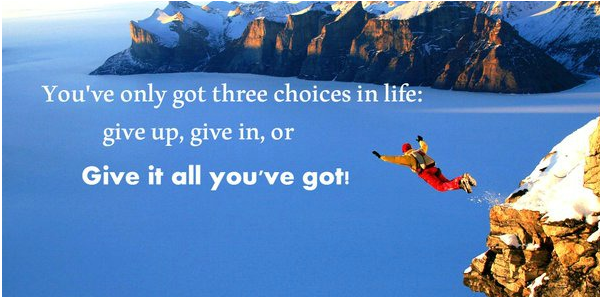
inspirational quote with man jumping off cliff

One of the common problems I’ve noticed people have isn’t about not knowing what they want out of life. It’s that sometimes they have too many passions to choose from, whether it’s entrepreneurship or startups, technology, filmmaking, screenwriting, book writing, music, personal development coaching, you name it.

People know they can’t do all of them, but at the same time they want to be successful with all of them. How do you know which one to go for?

Let me explain how I learned the hard way about picking something and staying with it. For 12 years, I was doing all of these businesses at once, jumping from one thing to another. The result of all of that? I was broke.

Finally, I chose just one business based not on how much money I would make, but on the fact that I was really interested in that topic, which was fitness.

I made a commitment that I would not leave that business until I was either legally bankrupt or a millionaire. In two and a half years, I became a millionaire.

So, if you have many passions, which one do you commit to?

Commit to something you’re passionate about right now! Or if you’re passionate about three things, what opportunity is in front of you right now?

For example, there were a few other passions I had other than fitness, but the fitness business was just starting at the time. I found a model to go by, decided to go with it, and it worked.

What is an opportunity that presents itself right now for you? That will at least narrow your options down.

The biggest issue with not knowing which route to take is that most people make the question “What do I do” this ball and chain for life decision. They’re thinking, “This is going to be my whole life here.”

Don’t be such a drama queen. What if it’s not a life decision? What if you took the pressure off?

In other words, choose and commit to something now, but don’t make it seem like you’re locked with that choice like it’s a prison of eternity. Give it a few years and if it doesn’t work, move on to one of your other passions.

Better yet, do one at a time and succeed at as many as you can, but be strategic about it.

Here’s my example. Many moons ago I was going to write a book. I hadn’t written anything before. I didn’t have a course or a training company at the time. I just knew, kind of, what I wanted to write about.

But then another voice came with an idea to create a seminar company. Wouldn’t it be better to test out the material live and see if people are actually interested?

It would take me a year to write a book, but for me to stand up in front of people and give this information, I could do that in a week. So I got eight people together at my house, tried out the material, and they loved it.

People started asking if they could bring their friends next time. Sure enough, I had another eight people two weeks later at the house, and I did the same program with some tweaks. Then I started writing up the program.

It took me a lot shorter time to write an event than to write a book. In about two weeks, I had a full one-day program. I put it out there, people loved it, and asked if I had anything more. It took on a life of its own.

I didn’t write the book until about 10 years later, but by then I had 250,000 people that had taken my trainings. When I wrote the book, guess what happened? It was a #1 New York Times bestseller. That was the best thing that could have happened to me.

Had I started out with the book first, I’d probably still be broke today. It just made sense to me to start small with what’s easiest, and I did. It was in my area of passion, which was training, personal development and business development.

I didn’t ask, “What’s the main thing in my life?” I asked, “What’s next?

What’s next for you?

What’s your experience with being a jack-of-all-trades but master of none? Or are you able to juggle multiple things at the same time successfully?

Share your stories…we want to hear from you!

NEW WEB CLASS ALERT:

Are you unsure or can’t figure out what your true PASSION or PURPOSE really is?

Are you stuck in a job, career or business that you don’t love but are forced to stay because you have bills to pay?

Do you feel like you know your true passion/purpose, but for some reason can’t seem to make any decent money with it?

If you answered yes to any of these questions, then you’re going to LOVE my new web class, Passion, Purpose And Profits.

It’s brand NEW and happens on June 14th.

I’d be honored if you’d join me, it’s FREE to attend.

Click Here to Reserve Your Seat and Get More Details Now »

For Your Freedom,

Want To Write A Book? Here Are 4 Important Things You Need to Know

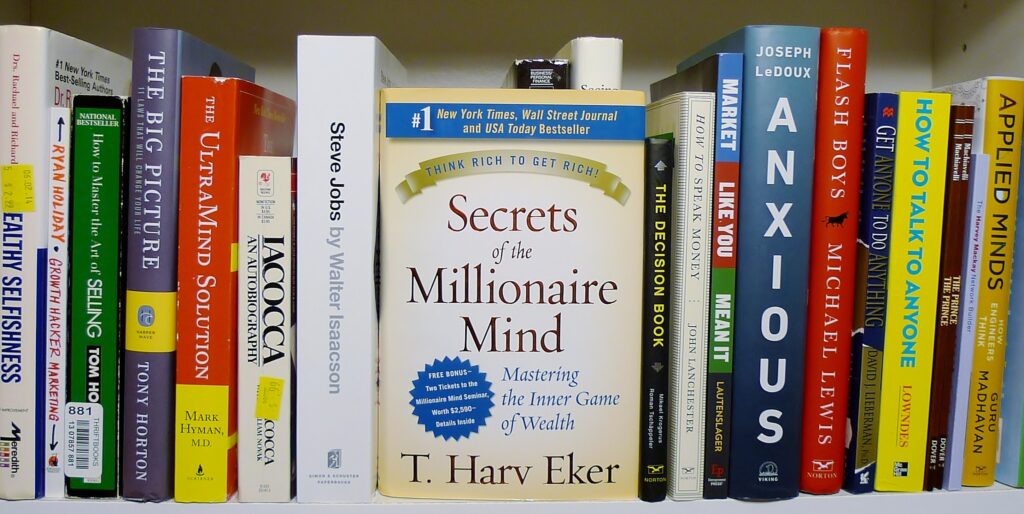
harv eker secrets of the millionaire mind

Authoring and publishing a book can do wonders for launching a business.

You are providing knowledge and information to people. Also, a book is a low-ticket item for clients to get started with. It’s part of them developing trust in you.

Unfortunately, most people go about book writing the wrong way or for the wrong reasons. If you love writing and just want to write, then write! But if you’re looking to make money off of a book, then that’s a whole different game.

Here are four things you need to know before you even think of getting started on writing a book.

1. Don’t shift focus away from what you mainly do in order to write a book.

Potential authors tend to think, “I’ve got to have a front-end piece, and the book is a good idea, so I’m going to take a year off to write and then I’m really coming back strong.”

That’s dumb. Do you know how I know? Because I almost did that.

It put nothing but stress on me. Do you know what the writing was like? Crap. Why? Because it had to work right away because I was broke and wasn’t making any money.

Don’t put stress on yourself. Whatever you’ve got going, keep it going. Don’t quit your day job until you are financially free enough to do so.

2. There’s no such thing as spare time.

Find me someone who’s got spare time, and I’ll show you someone who’s got broke time.

There’s no such thing as spare time. You have to make the time for writing as if it’s another job, so you say, “Instead of a vacation this year, I’m going to do a book writing vacation.”

Or make Friday book writing day. Or on Wednesday’s, instead of watching four television programs, you watch two, and then you take two hours to write. Make quality use of your time and you can get this done in a reasonable amount of time while attending to your other responsibilities.

3. Writing a book is useless; selling a book is useful.

If writing a book is healing for you–if you simply enjoy writing, that’s great. Do it. But if you actually want to do something from a business side, writing a book is basically useless.

Selling a book is a whole different matter as far as being useful and effective. Writing is one skill; selling and marketing another. The beauty of it is, you can combine both no matter what field you’re in!

If you’re selling fricking lighting and furniture, write a book about that! You’ll be known as the expert and people will come to you to buy furniture and lighting. People want to do business with experts.

4. Test the Topic First.

Why don’t you start with something shorter and easy to market? Test whether people like and want what you have to offer with an e-book, for example.

Instead of writing a 180 or a 250-page book and speculating on whether or not it would sell, why don’t you start with a 25-page report and try to sell that for $5, $10 or $20?

If your report can’t sell speaking and coaching, for example, then guess what? Your e-book and your book won’t either. You might as well start with something you can write in one freaking night and market tomorrow instead of a year and a half of fooling around, writing a book, and getting a publisher to find out you can’t sell it and nobody buys off of it anyway.

This advice isn’t meant to discourage, for example, purely creative writers from pursuing an ambition to make lots of money off of that. Most of these principles still apply.

Still, you don’t indeed have to be the next Stephen King in order to get stuff out there now no matter what business you’re in. Just do a little thinking and planning before you start something that could end up being a waste of time, effort, and money.

Do you have experience in writing that sold? What kinds of ideas can you or have you come up with to use written material as tools to promote or sell your business or service? Any successful (or even semi-successful) creative writers out there? What’s your experience in that area financially speaking?

Share your stories…we want to hear from you!

Self Publishing Success Summit

40+ World-Changing Entrepreneurs Reveal Their Secrets For Writing, Marketing, & Publishing Your First Book — AND Using It To Get to 6 Figures

I’m one of them! Come join me as my (free) guest.
Click here to get all the details and see who else is speaking with me.

For Your Freedom,