Select Language:

Practicing Happiness

elderly woman holding hands up in convertible

Practice makes perfect, right? Wrong!

First of all, nothing’s ever perfect. I’d even say you don’t really want anything to be “perfect.” Why not? Well, once you’ve reached it, where else is there to go but backwards or, even worse, nowhere?

No, the point of practice isn’t perfection. We want to strive for perfection, yes, but that’s only going to work if you understand that it’s not just about the destination but the journey as well. That’s why it helps to look at the process when it comes to those outcomes we’re reaching for. Because what would be the point of getting to where you always wanted to be if you’re beat up and worn out by the time you get there? Where’s the happiness in that?

Happiness is a process as much as an outcome. Don’t get me wrong – a hard-earned victory is awesome. But think about it; should happiness in life be restricted to success in finances, or business, or career, or the attainment of goals?

We have all been there at some point in our lives, saying something like, “If only I had [fill in the blank], I’d be so much happier.” Hey, sometimes we may even get whatever it is we think will make us happy, but what usually ends up happening? We’re psyched for a little while—if at all—and then we find out it wasn’t really enough to make us as happy as we thought it would. There’s always more.

You can work your butt off to get to where you want to be by practicing your delivery, your backhand swing, your investment strategies—you can practice anything until you get it down, but that doesn’t mean things are always going to turn out perfectly. Practice doesn’t make perfect.

Practice becomes habit, and habits become permanent unless we consciously change them. We’re practicing something all the time through our habits, even when we’re not really thinking about it. If you practice the thought that “I’ll be happy when [fill in the blank] happens,” then guess what? You’re always delaying your happiness until [fill in the bank] happens. Not because things will never be great, but because you’ve become a master at being unhappy. Unhappiness will be your habit!

You have to practice being happy no matter what is going on in life; whether you win or lose, succeed or experience temporary setbacks, whether everything is the way you have always dreamed or if you are still on the road to your next major destination.

Practice whatever you want to be in the future now. If you want to be more patient and less reactionary, then practice patience now. If you want to be a manager of your own personal wealth, start managing your finances now no matter how much money you earn. If you want to be successful, then practice being successful now. Start small. Engage in things that you’re already good at and challenge yourself to be better, even if it’s just in small increments.

The key is to enjoy the process and the journey. We can have moments of perfection, times where we wouldn’t want a single thing to change, but it’s unfair and unrealistic to ask that of life all the time. But it’s totally within our control to practice being whatever we want to be right now!

So now it’s your turn:  What are you going to practice right now?  What’s that one thing you want to achieve and are willing to enjoy the process while making it a habit?  We want to hear from you!

Get the Ball Rolling in 2013

2013 written in sand

After the initial enthusiasm over new years resolutions for 2013 dwindles, keeping motivated, committed and moving toward accomplishing those goals is often tough. For many of us, our resolutions slowly vanish from our daily thoughts and actions and we wind up creating those same EXACT resolutions the following year.


So what’s the secret formula to staying on track with your new years resolutions? 

Taking ACTION and staying CONSISTENT! To hell if conditions aren’t perfect, or if this circumstance isn’t quite ideal or that person isn’t following through the way they said they would. We’ve got to take all these principles learned throughout the years and put them into action.

This can become another one of those “Duh, Harv” moments. “Of course you have to take action and stay consistent.” But are these two principles that most people follow and really live by?

That’s exactly where a lot of people get stuck and give up on their goals, even those with greater awareness and knowledge. You know you want to work out, need to get into better shape for the sake of generating more energy to work your mission. But what step is often the hardest to take? It’s not the goal you set nor the resolution you create for yourself. It’s the first step that’s the hardest!

Sometimes getting the ball rolling can feel like pushing a boulder uphill, metaphorically speaking. You need to build the next muscle and final spiritual muscle that separates the successful from those still waiting at the gate: momentum.

Momentum is that force that makes it easier for someone who’s successful to do what’s right than to do what’s wrong. Momentum is that process of getting that snowball moving. The hardest part about working out is getting to the gym.  Once you get there, it’s not that hard to do.

When you’re in motion, that’s when things begin to line up, not before (that goes for you perfectionist!). A body in motion will remain in motion and a body at rest will remain at rest. What do we want to do? Get into motion! Once you’re there, it gets easier. We already know that. Now we need to just do it.

What in your life do you need to get started and adjust as you go? What have you been waiting for? What’s the fear? Is that true or did you just make it up?

For 2013, I challenge you to set smaller, incremental goals for yourself to gain momentum, and then adjust those goals as you go. Don’t forget to celebrate EVERY goal accomplished, no matter how small.

Now we want to hear from you! What changes will you make in 2013 to get the ball rolling and really gain some momentum for the best year of your life? Share your plans in the comments below and let our online community support you and give you ideas to move you in the right direction!

Happy New Year!  


Work Hard to Hardly Work

american gothic painting

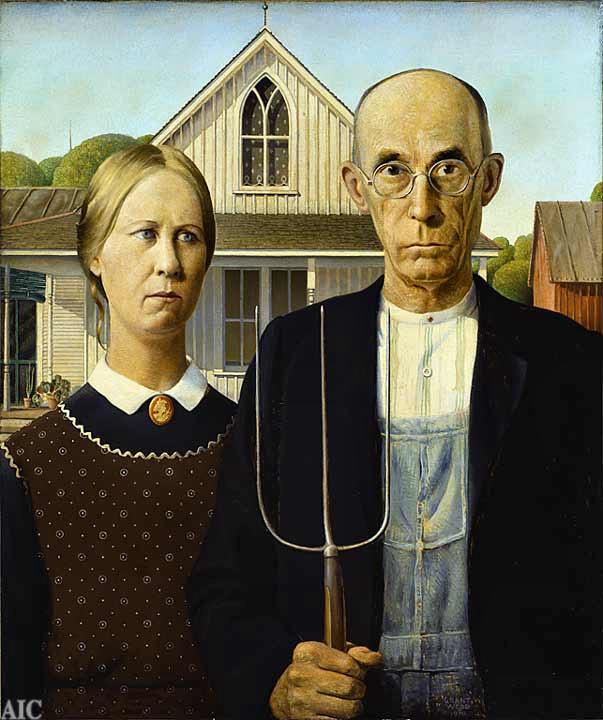
You’ve probably seen this painting periodically throughout your life called American Gothic by the artist Grant Wood. It shows an older man and woman, farmers presumably, standing stoically in front of a farmhouse, the man holding a pitchfork.

Art is subjective—what you see may not be what someone else sees—but even the casual viewer of this painting will see two people devoid of any emotion that would make the viewer stoked about the idea of ‘hard work.’

The painting, so the myth goes at least, points toward the idea that hard work is a rewarding virtue in itself. It’s implied as if the reward of hard work is something that just naturally happens as a result of our having ‘paid dues.’

Please understand I’m not ragging on farming or anything that requires hard, physical labor. I am, however, ragging on the idea that hard work is a ‘virtue’ that we should be carrying into our retirement years.

Unfortunately, these myths we grow up with impact our psychology more than we sometimes give credit. So many people judge success on superficial factors—like the prideful vanity of using a line like “I work hard” to bludgeon other people with—but also on the wrong metrics of measuring success to begin with. The number of hours worked and tasks completed may produce more money per paycheck, but it’ll also mean you’ll end up with those long, tight faces like in American Gothic.

Do years of hard work and little enjoyment of life, yet having a ‘comfortable’ retirement, equate to success? Maybe, but you could just as easily look at it as poor time management and a waste of personal strengths and skills—doing stuff that (often) makes us miserable for a little bit more money and for vanity’s sake—“I’m a hard worker.”

If we’re honest with ourselves, the only realistic goal of playing the money game while being truly happy and fulfilled is to play for eventual freedom from work—way sooner than retirement. Don’t misunderstand me here: the most valuable things in life aren’t going to come easy and they’re often not going to come without some pain and effort.

If you’re going to work hard, you might as well be working hard at working less.

The real measure of success is how free you are—financially, mentally, emotionally, and spiritually—to live life the way you want to live it.

Now it’s your turn, I want to hear from you! How are you going to practice working hard at working less right now? Or better yet, what specifically in the financial, mental, emotional and spiritual areas of your life will you practice this principle? Share your comments here, your feedback is valuable!

Don’t Sell – Help!

man with help above him

There are another three components that are critical to website success—besides avoiding the pitfall of focusing on product before knowing who your target market is and where they hang out.

The first is help, don’t sell. By helping you will sell. The second is build credibility and rapport through educating.

You’ll go to a sloppily put-together webpage and get these annoying boxes that come up asking if you want something you weren’t thinking about before but are certainly too annoyed by now to entertain considering.

When you’re marketing online, remember that people don’t shop online. People research online.

Most people go online for research on how to buy a new car, or increase their business, or to learn about raw foods, or whatever it may be. So your website has to be designed around helping, not selling. Informing, revealing, educating.

If you sell, you will fail. By helping you build credibility and rapport. People will believe in you, and because of that, you can show them the value in your product or service. And they will buy from you. It’s absolutely critical to what you do online.

Everything on your website—every button, every graphic, every word you put on the page has got to be built around helping, not selling. Make it most appealing to researchers, not to shoppers. Save the two-page sales letters and the paper. Whatever it is you’re the expert in, whatever you do, they want more information. They’ll call you, email you, or order right off the website.

The mindset of the online researcher-pre-shopper is, What’s in it for me? That’s the first question you want to answer on your website. If you can’t answer that question at the top of your webpage, change it or you’re going to fail. Why should anybody stay there? They’ve got hundreds of websites to go look.

Don’t have a mission statement at the top of your page talking about who you are, what you do, how great and fantastic you are, and how you have a Ph.D. Nobody cares about that.

They care about what you’re going to do for them. That doesn’t mean not making available credentials and testimonials, but it all goes back to writing headlines—something that will make them stay. Suck them in. Make them feel like they’re going to be learning something they didn’t know before.

Nearly the same marketing rules still apply. Walk a mile in your prospects’ shoes. Empathize with them in plain language. Pharmaceutical ads are written and spoken so that children understand them. Use simple and/or precise language (depending on the uniqueness of your market) as your keywords—the words prospects would be typing into Google or Bing to find you. If you’re selling cow juice but everyone calls it milk, you better call it milk too because people don’t search for cow juice, they search for “milk.” If you get stuck, there are writers at reasonable prices who can do it for you.

It’s not how well you know your product that is going to determine the level of your sales and your success; it’s how well you know your customer, so that you’re ready for them when they visit your web page.

Next month we’ll cover that last key to success in building an online business—having the best possible sales process you can have—one that costs you nothing and boosts your profits!

https://bit.ly/UltimateInternetBootcamp

Give ‘Em What They Want … and More

buy now button on laptop

Do a little digging and you find out it’s relatively easier to make that million-dollar mission-accomplished by finding an online niche–preferably one that actually excites you at your core–and finding out what that niche want.

Too many people do the opposite–they focus on the hottest product or service and try to blast that out to as many people as possible. There’s an inherent risk in being left holding a bag of goodies nobody wants. Only that’s one expensive bag!

Just like the old-fashioned way, you’re not buying tons of inventory and then hoping that you sell it. You get the orders and the money first, then you deliver. Online, you learn your market’s want or gap in fulfillment, and then you deliver a product or service that market wants. Social media is a great way to learn more about your market (and pull in very qualified leads!) once you’ve established what your niche will be and build your website around it.

As usual, proceed with caution. Not everything can be sold online. Not every want that might be clear and evident can be fulfilled just by throwing up a website.

The late Cory Rudl, one of the pioneers of internet marketing and online businesses, used this analogy. If you had a cure for the common cold, in an easy-to-digest pill form, billionaire might not even apply to what you’d be worth. That product would be everywhere–Seven Eleven, every grocery store, corner store, market, you name it.

Now try selling that online. At minimum it takes at least three to four days for the product to get to you. You’re already over your cold by then. It’s a failure from day one. Don’t start with a product. Start with a market, and then find a product for that market that that market wants.

People spend money on things that they want. It’s an emotional investment. A necessity can be satisfied by the most convenient and cheapest product or service. People are willing to pay more money for wants, but they’re usually very price-conscious with things they have to get or do.

And no different than traditional businesses, there’s the backend after that want is fulfilled. It’s the product or service you sell after they’ve bought the first product from you. That’s where all the money is.

Been to the movies lately? If not, no one can blame you as expensive as it can be to take your family out for movie night. But think about whoever is making all that money at the concession stand alone.

You go up to the counter for a small popcorn (because you’ve already tucked away all the candy you’ll need in your purse or bag), but you leave with a large bucket plus a soda. Why? "Well, you can get this for only 40 cents more … Or this meal-deal that saves you this much money."

Even fast-food workers are routinely taught to up-sell. It’s no different online–the point is your customers come in for one thing and walk away with more–because you gave them something they wanted from the beginning.

Once you have the customer’s name online, it costs you nothing to sell to them again and again and again. You can make 100% more net income than you are right now by back-end selling.